Showing posts with label #biodiversity. Show all posts

Monday, 1 August 2016

Sonic the Hedgehog


On the 7th July I was working in the car park next to the 3G pitches and happened to see this little guy shuffling across the tarmac and then into the border. I love seeing wildlife like this on campus because it just shows how diverse our campus can be with the amount of wildlife we come across.
This one was an adult as, although its hard to tell on the photograph, it was actually quite large.
Then on the 27th July whilst litter picking on a morning before the morning graduation took place I saw this little guy in the grass.


Now this one had me concerned because its very unusual to see a baby hedgehog curled up in plain site in an open grassed area during the day. So I did a little research online and got in contact with the Hedgehog Society and I found out that should you ever find a hedgehog like this then it needs urgent care and assistance.

So I'd just like to share some information with you about the hedgehog otherwise known as Erinaceus europaeus.
Although once a common sight across the British Isles but not on the Scottish Islands, it is now in severe decline with an estimate in 2010 of just 1 million now in the wild (1).
A hedgehog can have between 5000 and 7000 spines on their body and what many people aren't aware of is that they do actually have a small tail (2).
Their dietary needs consist mainly of insects but they are known to be partial to a bit of dog food and it does help to put out a saucer of water especially during the summer season.
Should you find a baby hedgehog called a Hoglet sunbathing like I did last week then this does need urgent care. The only reason for them to do this is to try and warm up. So should you find one then you should put it in a fleece or towel lined box using thick gardening gloves, and place a bottle of warm water either underneath or to the side of the hoglet to try and warm it up.


Then you should call your local hedgehog rescue centre or the Hedgehog Preservation Society (01584 890 801) to find out your next step.
Unfortunately for the little guy I found, it was too late. I managed to get him into a box with a warm water bottle and took him to my local rescue but just as we arrived he passed away. It was rather heart wrenching as we got so close but not soon enough. So should you find yourself in a similar situation please do try and save them asap as they are becoming an endangered species within Britain, as it would be such a shame for this species to become extinct.


1: http://www.britishhedgehogs.org.uk/pdf/SoBH_2015.pdf
2: http://www.britishhedgehogs.org.uk/leaflets/L9-Basic-Facts.pdf

Photographs taken by myself on 7th July and 27th July.

Wednesday, 15 June 2016

As wise as an owl...


This photograph of a gorgeous tawny owl was taken by Rach on the 11th April in a secluded area of woodland just behind the polytunnels at our garages. So this is our bird of the day today.


The tawny owl, otherwise known as Strix aluco in Latin is part of the Strigidae (owl) family.

This bird is roughly the size of a pigeon and has a rounded body and head, with a dark circle of feathers around its face. It is mainly reddish brown when seen from above or behind but the underside is paler. 

The tawny owl is a nocturnal bird and is often heard calling at night but not often seen. Normally you would only catch a glimpse of one during the day if you happen to disturb its nesting site.

It is widespread across England, Scotland and Wales, but not in Ireland. There are approximately 50,000 breeding pairs across the UK and they can be seen all year round if you are very lucky.

Tawny owls like to feast on small mammals and rodents, small birds, frogs, fish, insects and worms. 

Established pairs of tawny owls usually don't leave their territories, whilst their young disperse in the autumn to find their own patch of land. So potentially we have an established owl living in our own backyard which really shows just how much our biodiversity action plan is doing to benefit the surrounding wildlife.


(Information on the tawny owl and other bird species can be found on the RSPB website)


Thursday, 31 March 2016

Not a post about Brandon Lee...


If I could get away with a post all about the film then I would but alas this is a gardening blog.
I spotted a couple of crows hopping about next to the Priestley building as I was working there, so here is my bird of the day.
The carrion crow (Corvus corone) is part of the Crow family (Corvidae).


It is one of the cleverest and most adaptable of our birds. They are usually solitary creatures and often found alone or in pairs. They will come to a garden for food and can very quickly work out whether it is safe, and will return often to take advantage of whatever is on offer. Their diet consists of carrion (dead and decaying animal flesh), insects, worms, seeds, fruit, and any scraps they can find.
They can be found all year round almost everywhere, from cities to moorland, and woodland to seashore.

(Photograph taken by myself, Thursday 31st March)

(Information taken from the RSPB website, www.rspb.org.uk)

Friday, 26 February 2016

Getting rid of the deadwood...

Yesterday Carl and Paul were working in the wood at the back of Churchwood, planting some new trees to replace ones that had been felled at height. The old trees had to be removed as they were becoming rotten at the base which poses a significant safety hazard for people walking by.


The were chopped at a height to allow the trees to become deadwood and habitable for wildlife. A tree left like this can become a home to many different species, from fungi to insects to birds. It is a part of the university's biodiversity action plan to create habitats for wildlife, and by leaving trees like this in the woodland we are promoting our conservation and biodiversity efforts.
These trees were replaced with three beech saplings which should grow pretty quickly in this area with there being so much sunlight and open space now.


The old branches have been left in piles within this section of woodland to create habitat piles which can be very good for encouraging more wildlife into the area, such as hedgehogs, as they provide excellent shelter for the colder and wetter months.
Further up the woodland, Carl and Paul planted some more beech saplings to encourage more growth in an open area.


We have new ties now which attach the tree to the stake for support but are designed like a belt. This way we can easily slacken the tie as the tree grows rather than having to cut off the old tie to replace it with a new one. It shouldn't take long for the new trees to become established but we will be keeping an eye on them to make sure they are thriving.

(Photos taken by myself on Thursday 25th February)

Friday, 12 February 2016

One for sorrow, two for joy...

As I walked along the bottom of the acre yesterday I saw a magpie hopping around looking for worms. So this is my bird of the day. We get quite a few magpies on campus and non breeding birds will normally gather in flocks which is why there are always several together.


The magpie (Pica pica) is part of the crow family (Corvidae).
It stands out amongst other members of the crow family with its black and white feathers that have a purple/blue sheen to the wing and a green gloss to the tail.
The magpie is a scavenger, predator and pest destroyer who is an omnivore, which is to say they will eat other animals, plants, seeds and nuts, fruit, insects, and eggs.
They can be found all year round across the UK from lowland farmland to upland moors, but they are absent from the Scottish Highlands.


More information is available from the RSPB website (http://www.rspb.org.uk)

(Photo taken by myself on 11th February 2016)


Friday, 29 January 2016

I've got my eye on you...


I took this picture when we had all the frost on 21st January but I couldn't resist choosing him as my bird of the day today. I never truly realised just how much wildlife we have on campus so I'm really going to keep my eye out in the future for more pictures.
So here's the blurb about the Blackbird or as its Latin name, Turdus merula, for you. It is part of the Turdidae family of chats and thrushes.
The male of the species are the most recognisable as they live up to the name of Blackbird, whereas the female is brown with speckles or streaks on the breast. They really stand out in the garden with their yellow/orange eye ring and beak. The eyes are just like those ones you get for stuffed teddy bears.
The blackbird can be found pretty much all over the UK and worldwide really, anywhere from gardens to countryside to coasts to hills, unless they are high peaks. This bird can be rather partial to insects, worms, and berries for their diet. So make sure you have plants such as Holly and Cotoneaster horizontalis that produce berries in your borders, well tended healthy soil and even a bug hotel to attract them to your garden.


You can quite easily buy a bug hotel at your local garden centre but should you have the materials to hand then you could make your own. All you really need is some wood, bamboo canes and straw or leaves and pile it up in your border. The insects want somewhere they can wiggle their way in to for protection and shelter. By having one of these in your garden, you are more than likely to get some inhabitants which will increase the biodiversity in your garden and will increase the likeliness of birds visiting you. If you do this then I bet you're more than likely to get some amazing wildlife right in your back yard!

Check out the RSPB website for more information www.rspb.org.uk

#biodiversity #wildlife #birds

(Pictures taken by myself on 21st January and 23rd January 2016)

Can't see the wood for the trees


This is just a little bit of the woodland at Churchwood. The path runs all down the side of the campus connecting North Lodge to South Lodge. It mainly consists of beech (Fagus sylvatica), holly (Ilex aquifolium), laurel (Laurus nobilis) and birch (Betula pubescens). It's used by dog walkers, cyclists, and students.

Ilex aquifolium
In this woodland, as with the one at the opposite end of campus, Queenswood, there are several bird and bat boxes to try and encourage more wildlife onto the campus.


It's not possible for me to say whether or not they are being utilised as we don't monitor their usage, but it would be great if we could. The last time bat boxes were affixed to trees was in 2012 by Paul, Carl and myself. Hopefully next year we will be putting some more bird boxes as well as bat boxes up.


At the opposite end of campus is the woodland known as Queenswood. This woodland is very similar  to Churchwood in that it contains the same variety of trees. This woodland is used mainly by dog walkers and a student running group. The paths are extremely muddy at the moment so take care if you walk through the wood!


One of the stand out sections of this woodland has to be the Queen Victoria monument. No one really knows its origin except that it was created in 1858. Some say it was built as a celebration of Queen Victoria's 39th birthday but no-one really knows for sure. If it was for her birthday then it was such a shame as she didn't even turn up!


The grounds team are in the process of clearing some of the trees from this wood to try and open it up a bit more and to allow stronger trees to develop. There is a lot of overcrowding in some patches so we need to thin these out so that at least some of the saplings have a chance. By doing so we are encouraging more ground cover plants to appear which is great for the local wildlife and it allows visitors and members of the public to see all the gorgeous bluebells that are starting to appear.


Fingers crossed we don't get too much frost or snow which could kill off these bulbs before they flower. The weather seems a bit crazy at the moment so a lot of plants are thinking spring is already here and are starting to get their buds or even, like these daffodils, starting to flower!


#woodland #wildlife #trees
(Photos taken by myself on Thursday 28th January, daffodils taken on Tuesday 26th, and Paul putting up the bat box in 2012)

Thursday, 28 January 2016

Spotted at the bird feeder

On Tuesday I happened to walk by the bird feeder at The Cottage at the perfect time. I spotted a Blue Tit pecking at some nuts. So this is my bird of the day today!


It took awhile to get a good picture as the little guy kept jumping around the cage just as I was about to take a picture.

So here's a little bit of information about the Blue Tit or as known by it's Latin name: Cyanistes caeruleus. It is part of the Tit (Paridae) family. It's one of the more recognisable garden birds with its blue, yellow and white markings. In Spring, the young blue tits have yellow instead of white cheeks.
They can be found not only in gardens, but woodland, hedgerows and parks too. Their diet consists mainly of insects, caterpillars, seeds and nuts. A bird feeder with 4-5 blue tits at it may be feeding 20 or more of their family. So make sure to keep your bird feeders and tables topped up for our little feathery friends.


Head to the RSPB website for more information. www.rspb.org.uk

#birds #wildlife #biodiversity

(Pictures taken by myself on 26th January 2016)

Tuesday, 26 January 2016

Jaywalking...

No it's not a post about jay walking in America, this is about my bird of the day.

It was very difficult to get a clear picture of the Jay in the Queenswood woodland as it kept moving about just as I was about to take a picture. I apologise for the blurriness, it may be a case of Where's Jay, rather than Where's Wally? (Waldo for our American readers). I was disappointed as I'd just set up the perfect shot and then a loud bang from a nearby skip frightened it, so it flew away.


The Jay or as it's Latin name: Garrulus glandarius, is a member of the Crow (Corvidae) family. They are the most colourful of the Crow family but are rather shy and prefer to be hidden in the woodland. They are normally spotted when flying from tree to tree in search of food as they emit a screeching call. It can be found across the United Kingdom and in pretty much any woodland, park, and mature garden, and has a penchant for acorns. They also eat nuts, seeds and insects, but they do also have a liking for the nestlings of other birds and small mammals.

I used some of this information from the RSPB website as I'm afraid I don't really know much about birds, but hey, now I do :)
Just so you know, should you wish to take part, it's the Big Garden Birdwatch on the 30-31st January. Go to the RSPB website for your information pack. The birdwatch is all about spending an hour watching your garden and spotting the birds that visit. This means you'll be taking part in the world's largest wildlife survey. It's definitely worth taking part. www.rspb.org.uk

#wildlife #conservation #birds

(Picture taken by myself on 25th January 2016)

Friday, 22 January 2016

That's not the bird we were looking for...


Well, when we installed the bird tables a couple of weeks a go I was really hoping we would get a wider variety of birds than this! This is the bird table at Carnegie.
I was thinking something more along the lines of blue tits, robins, sparrows...not pigeons! Oh well, at least it's being used. Maybe in the future more birds will come and use the feeders. I did notice that most of the seeds in the middle feeders on all three tables has gone, so unless the pigeon is ridiculously greedy then other birds must be using them. I'll keep an eye out should I see more visitors to the tables and keep you all appraised of any developments.

I did see some blue tits on my walk round whilst taking winter interest pictures at the back of Bronte so they are out there somewhere!


(Photos taken by me on the 21st January 2016)

What's out there in winter?


What to see in winter on the campus


Well it was a lovely crisp winters day yesterday on campus with a gorgeous sunrise. When I drove into work it was -2 degrees Celsius, but it did warm up to a toasty 1 degree by lunchtime! It was fantastic to walk around the Headingley campus all wrapped up nice and warm, to capture some of the stunning colour that there is to see in winter. Some people may think that there isn't much to see in winter time in gardens but I'm here to prove you wrong.

(http://www.leedsbeckett.ac.uk/our-applicants/visiting-us/getting-to-headingley-campus/)

I've included the map of the campus so you know where I'm taking about and where you can go on your break to see some winter interest.

The first place I visited was Fairfax (10) and here there is the fantastic colour from both the foliage of the ground cover plant, Geranium macrorrhizum 'Mytikas' and the tall Phormium tenax 'Yellow Wave'.

Next I visited the borders of the main campus building, James Graham (1). These borders are used as a focal point when graduation time comes round as the roses are in full bloom. The acre is used for the marquee for graduates and their families to congregate and have a drink and celebrate, so the borders of James Graham always have to look their best for being in those family photos!
Here we have 1) Euphorbia characias subsp. wulfenii, 2) Skimmia japonica ‘Fragrans’, 3) Ilex aquifolium ‘Golden King’, 4) Mahonia x media ‘Arthur Menzies’, 5) Viburnum tinus ‘French White’, and 6) Viburnum davidii.


1


2
3
4
5
6
As you can see from the pictures, that although the borders are at their best in the summertime, there is still quite a bit of colour to view in the winter.

At the student hub area (left of 2), we have four raised beds with a variety of shrubs in them. Again although they are at their best in the summer, it's worth looking out for the Cornus stolonifera 'Flaviramea'. This is a dogwood grown for its winter interest of gorgeous green stems.
Over at The Cottage (21) we have a small border with a variety of shrubs but now's the time to see 7) Hebe 'Pink Elephant' with its vibrant purple foliage, and 8) Cornus alba 'Spaethii' with its deep red stems.
7

8
At the north entrance to the campus we have the building known as North Lodge (23) and here you will find 9) Skimmia japonica 'Nymans' with its bright red berries and lush green leaves.
9
If you happen to find yourself at the bottom of the steps to the refectory near the student bar (right of 2) then you will find another plot of shrubs providing greenery for the winter. In this you will find two Hebes, Cornus nitida "Bagessons Gold', Cornus sericea 'Flaviramea', Garrya elliptic 'James Roof', Santolina chamaecyparissus, Bergenia cordifolia 'Rosa Zeiten', Berberis thundergii f atropurpurea 'Harlequin', and Choisya ternata 'Sundance'.
10
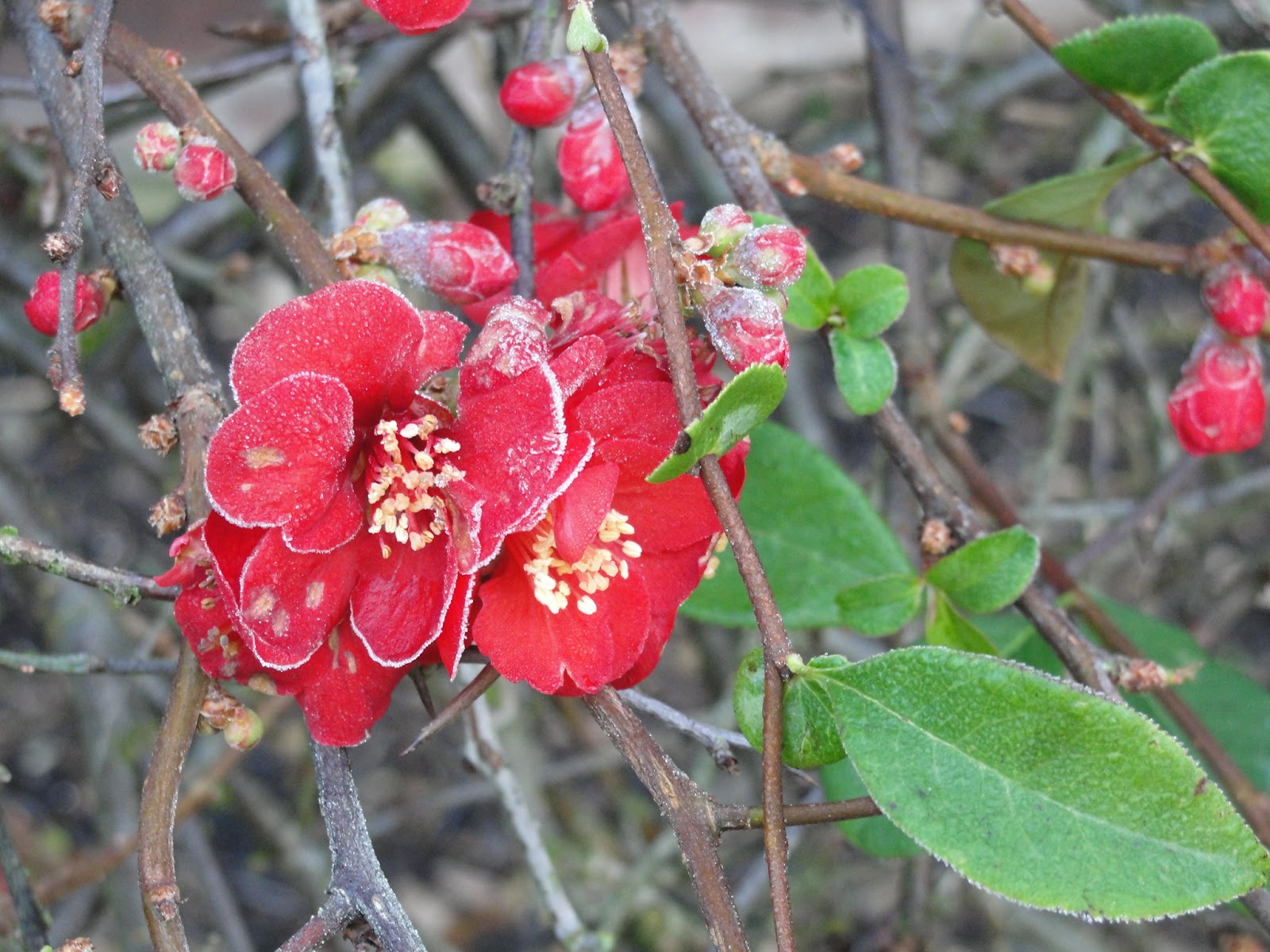
Should you get the chance then it is definitely worth having a wander across to Churchwood (22), as here will will find a shrub called Chaenomeles x superb 'Crimson and Gold'. This shrub has a fantastic display of red flowers that it is definitely worth seeing. 
11
11
Carry on down to Priestley (4) and you will find 12) Helleborus x hybridus 'Peggy Ballard' and 13) Fuchsia 'Billy Green'. 
12
13
We also have some lovely green foliage dotted around campus which does bring a lot of colour to the site in itself. At Carnegie (12) we have some 14) Phyllostachys bambusoides which provides a lovely green leaf with cream stems, and a 15) Aluba japonica 'variegata' which provides a variegated green and yellow spotted leaf for winter interest.

14
15
I hope you have enjoyed this visual walk around the Headingley campus with me. As you can see there really is still colour and interest going on out there in the winter time. No longer can you say there's nothing to see in winter, as clearly there is! Until next time, get wrapped up and get out there to enjoy the scenery.
  

(All photos were taken by myself on the 21st January 2016)

Tuesday, 19 January 2016

Installation of Bird Tables

Bird Tables on Campus


On the 8th January, Carl, Paul and Sam installed three bird tables on the Headingley campus. These bird tables can be bought at your local garden shop along with the bird feeders and food. 
The tables were introduced as part of the wider biodiversity action plan we have to increase wildlife on campus and improve the diversity of species found.
The first one was placed by the raised pond at Carnegie Hall so is in an excellent position for staff to see, from their offices, the birds visiting the table.


The second was placed by The Cottage in a perfect position for the staff inside the building to see the table, but also for people sitting in the refectory across the road. It should be an excellent position to spot all the visitors to the table.


The third was placed in the front garden at North Lodge, again in a perfect spot for staff inside the building to watch the wildlife. 


It will be fantastic to find out from the staff inside these buildings just what birds have visited the tables. So I will keep this blog posted for any sightings. Chances are theres will be some other creatures visiting the tables, such as squirrels but some of the feeders are specially designed to stop them from getting at the food, this will ensure that the birds are able to feed too.

The bird feeders will be topped up regularly in winter time by Paul to ensure the birds always have a supply of food should there not be many berries and seeds out there naturally for them. It has been suggested that feeders should only be used in the winter months when natural food supplies in the wild are low. That way the birds do not become reliant on bird feeders and are still able to forage for themselves. As birds use what they have found to feed their young in the springtime we do not want them relying on seed, as these can potentially choke the chicks as the seeds can sometimes get stuck in their throats. So we will do what we can to help them through the winter, then they have a fighting chance to survive the rest of the year.


(These photos were taken by myself on the 8th January 2016)