Friday, 29 January 2016

Can't see the wood for the trees


This is just a little bit of the woodland at Churchwood. The path runs all down the side of the campus connecting North Lodge to South Lodge. It mainly consists of beech (Fagus sylvatica), holly (Ilex aquifolium), laurel (Laurus nobilis) and birch (Betula pubescens). It's used by dog walkers, cyclists, and students.

Ilex aquifolium
In this woodland, as with the one at the opposite end of campus, Queenswood, there are several bird and bat boxes to try and encourage more wildlife onto the campus.


It's not possible for me to say whether or not they are being utilised as we don't monitor their usage, but it would be great if we could. The last time bat boxes were affixed to trees was in 2012 by Paul, Carl and myself. Hopefully next year we will be putting some more bird boxes as well as bat boxes up.


At the opposite end of campus is the woodland known as Queenswood. This woodland is very similar  to Churchwood in that it contains the same variety of trees. This woodland is used mainly by dog walkers and a student running group. The paths are extremely muddy at the moment so take care if you walk through the wood!


One of the stand out sections of this woodland has to be the Queen Victoria monument. No one really knows its origin except that it was created in 1858. Some say it was built as a celebration of Queen Victoria's 39th birthday but no-one really knows for sure. If it was for her birthday then it was such a shame as she didn't even turn up!


The grounds team are in the process of clearing some of the trees from this wood to try and open it up a bit more and to allow stronger trees to develop. There is a lot of overcrowding in some patches so we need to thin these out so that at least some of the saplings have a chance. By doing so we are encouraging more ground cover plants to appear which is great for the local wildlife and it allows visitors and members of the public to see all the gorgeous bluebells that are starting to appear.


Fingers crossed we don't get too much frost or snow which could kill off these bulbs before they flower. The weather seems a bit crazy at the moment so a lot of plants are thinking spring is already here and are starting to get their buds or even, like these daffodils, starting to flower!


#woodland #wildlife #trees
(Photos taken by myself on Thursday 28th January, daffodils taken on Tuesday 26th, and Paul putting up the bat box in 2012)

Thursday, 28 January 2016

Mind your head...

Today Rach and Paul had the task of pulling down branches that had snapped off but were still hung in the trees. These can cause a bit of a problem should a visitor walk underneath and the branch suddenly fall down. So for health and safety purposes we have to get them before they get someone else (the branch, not the visitor). Please don't start picturing us running around chasing down visitors with branches, we really don't do that.

The branches that had been spotted were on South Drive where a lot of students cross onto campus from the park, so out came the extendable loppers and with a bit of a stretch success was had.


(Pictures taken by myself on 28th January 2016)

Path Maintenance

On Monday Paul, Carl and Sam worked in the Churchwood woodland clearing a section of path that connects the university to St Chad's church. This pathway is used regularly by dog walkers, runners, and students amongst others to get from Headingley onto the campus. Over time the path has become muddy and boggy and is very difficult to pass through without wellington boots on.


As a quick solution when it has become so boggy, there has been mulch or wood chippings put down which then over time rots down and more has just been put on top. So to combat this in the meantime, the team dug up the pathway to get the level back down to the stone and rubble underneath all the detritus. They dug up the path on the campus side of the wall and also on the church side as that too had become very boggy with all the pedestrian traffic. It was a hard task to undertake as the build up of mud and old chippings had become sodden with water and so was heavy to move.


We saw the vicar when we were working down there and he told us that there had been a very kind donation to St Chad's Church of four large builders' bags of wood chippings. So he very generously said we could use these to create the path through from the church to the campus side.


A layer of wood chippings was spread out over the ground to create the new path and hopefully this will stop the area from becoming so muddy.


In the future when the area has dried out, we will hopefully put down some gravel or larger stones to create a better path. If we continue down the road of chippings, then these need to be replaced every year as they do just rot down to create the muddy paths of before. In the meantime this temporary fix should keep the area free from mud for quite awhile, much to the appreciation of the local dog walkers.


(Photos taken by myself on 25th January 2016)


Spotted at the bird feeder

On Tuesday I happened to walk by the bird feeder at The Cottage at the perfect time. I spotted a Blue Tit pecking at some nuts. So this is my bird of the day today!


It took awhile to get a good picture as the little guy kept jumping around the cage just as I was about to take a picture.

So here's a little bit of information about the Blue Tit or as known by it's Latin name: Cyanistes caeruleus. It is part of the Tit (Paridae) family. It's one of the more recognisable garden birds with its blue, yellow and white markings. In Spring, the young blue tits have yellow instead of white cheeks.
They can be found not only in gardens, but woodland, hedgerows and parks too. Their diet consists mainly of insects, caterpillars, seeds and nuts. A bird feeder with 4-5 blue tits at it may be feeding 20 or more of their family. So make sure to keep your bird feeders and tables topped up for our little feathery friends.


Head to the RSPB website for more information. www.rspb.org.uk

#birds #wildlife #biodiversity

(Pictures taken by myself on 26th January 2016)

Tuesday, 26 January 2016

Jaywalking...

No it's not a post about jay walking in America, this is about my bird of the day.

It was very difficult to get a clear picture of the Jay in the Queenswood woodland as it kept moving about just as I was about to take a picture. I apologise for the blurriness, it may be a case of Where's Jay, rather than Where's Wally? (Waldo for our American readers). I was disappointed as I'd just set up the perfect shot and then a loud bang from a nearby skip frightened it, so it flew away.


The Jay or as it's Latin name: Garrulus glandarius, is a member of the Crow (Corvidae) family. They are the most colourful of the Crow family but are rather shy and prefer to be hidden in the woodland. They are normally spotted when flying from tree to tree in search of food as they emit a screeching call. It can be found across the United Kingdom and in pretty much any woodland, park, and mature garden, and has a penchant for acorns. They also eat nuts, seeds and insects, but they do also have a liking for the nestlings of other birds and small mammals.

I used some of this information from the RSPB website as I'm afraid I don't really know much about birds, but hey, now I do :)
Just so you know, should you wish to take part, it's the Big Garden Birdwatch on the 30-31st January. Go to the RSPB website for your information pack. The birdwatch is all about spending an hour watching your garden and spotting the birds that visit. This means you'll be taking part in the world's largest wildlife survey. It's definitely worth taking part. www.rspb.org.uk

#wildlife #conservation #birds

(Picture taken by myself on 25th January 2016)

Friday, 22 January 2016

That's not the bird we were looking for...


Well, when we installed the bird tables a couple of weeks a go I was really hoping we would get a wider variety of birds than this! This is the bird table at Carnegie.
I was thinking something more along the lines of blue tits, robins, sparrows...not pigeons! Oh well, at least it's being used. Maybe in the future more birds will come and use the feeders. I did notice that most of the seeds in the middle feeders on all three tables has gone, so unless the pigeon is ridiculously greedy then other birds must be using them. I'll keep an eye out should I see more visitors to the tables and keep you all appraised of any developments.

I did see some blue tits on my walk round whilst taking winter interest pictures at the back of Bronte so they are out there somewhere!


(Photos taken by me on the 21st January 2016)

What's out there in winter?


What to see in winter on the campus


Well it was a lovely crisp winters day yesterday on campus with a gorgeous sunrise. When I drove into work it was -2 degrees Celsius, but it did warm up to a toasty 1 degree by lunchtime! It was fantastic to walk around the Headingley campus all wrapped up nice and warm, to capture some of the stunning colour that there is to see in winter. Some people may think that there isn't much to see in winter time in gardens but I'm here to prove you wrong.

(http://www.leedsbeckett.ac.uk/our-applicants/visiting-us/getting-to-headingley-campus/)

I've included the map of the campus so you know where I'm taking about and where you can go on your break to see some winter interest.

The first place I visited was Fairfax (10) and here there is the fantastic colour from both the foliage of the ground cover plant, Geranium macrorrhizum 'Mytikas' and the tall Phormium tenax 'Yellow Wave'.

Next I visited the borders of the main campus building, James Graham (1). These borders are used as a focal point when graduation time comes round as the roses are in full bloom. The acre is used for the marquee for graduates and their families to congregate and have a drink and celebrate, so the borders of James Graham always have to look their best for being in those family photos!
Here we have 1) Euphorbia characias subsp. wulfenii, 2) Skimmia japonica ‘Fragrans’, 3) Ilex aquifolium ‘Golden King’, 4) Mahonia x media ‘Arthur Menzies’, 5) Viburnum tinus ‘French White’, and 6) Viburnum davidii.


1


2
3
4
5
6
As you can see from the pictures, that although the borders are at their best in the summertime, there is still quite a bit of colour to view in the winter.

At the student hub area (left of 2), we have four raised beds with a variety of shrubs in them. Again although they are at their best in the summer, it's worth looking out for the Cornus stolonifera 'Flaviramea'. This is a dogwood grown for its winter interest of gorgeous green stems.
Over at The Cottage (21) we have a small border with a variety of shrubs but now's the time to see 7) Hebe 'Pink Elephant' with its vibrant purple foliage, and 8) Cornus alba 'Spaethii' with its deep red stems.
7

8
At the north entrance to the campus we have the building known as North Lodge (23) and here you will find 9) Skimmia japonica 'Nymans' with its bright red berries and lush green leaves.
9
If you happen to find yourself at the bottom of the steps to the refectory near the student bar (right of 2) then you will find another plot of shrubs providing greenery for the winter. In this you will find two Hebes, Cornus nitida "Bagessons Gold', Cornus sericea 'Flaviramea', Garrya elliptic 'James Roof', Santolina chamaecyparissus, Bergenia cordifolia 'Rosa Zeiten', Berberis thundergii f atropurpurea 'Harlequin', and Choisya ternata 'Sundance'.
10
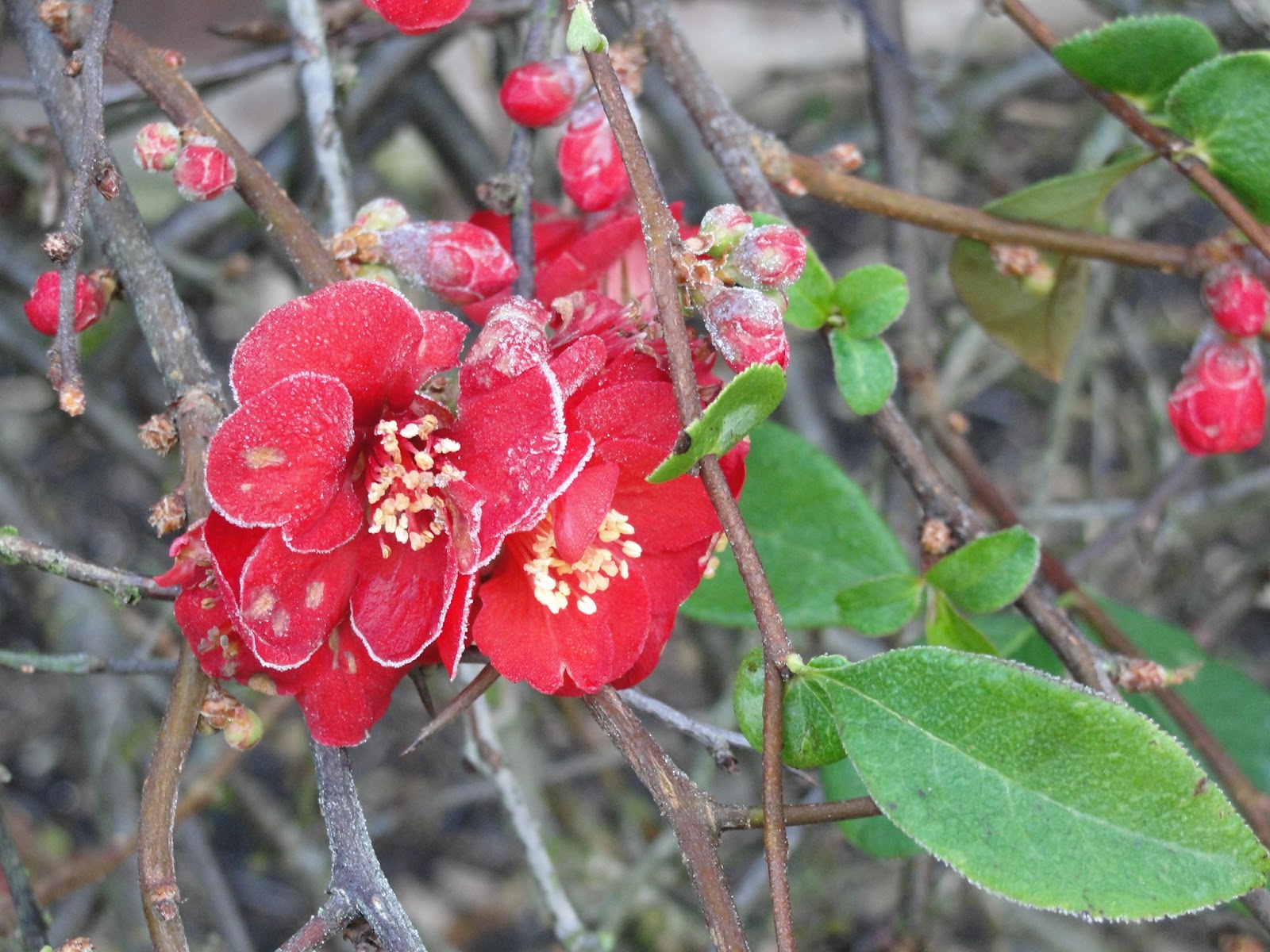
Should you get the chance then it is definitely worth having a wander across to Churchwood (22), as here will will find a shrub called Chaenomeles x superb 'Crimson and Gold'. This shrub has a fantastic display of red flowers that it is definitely worth seeing. 
11
11
Carry on down to Priestley (4) and you will find 12) Helleborus x hybridus 'Peggy Ballard' and 13) Fuchsia 'Billy Green'. 
12
13
We also have some lovely green foliage dotted around campus which does bring a lot of colour to the site in itself. At Carnegie (12) we have some 14) Phyllostachys bambusoides which provides a lovely green leaf with cream stems, and a 15) Aluba japonica 'variegata' which provides a variegated green and yellow spotted leaf for winter interest.

14
15
I hope you have enjoyed this visual walk around the Headingley campus with me. As you can see there really is still colour and interest going on out there in the winter time. No longer can you say there's nothing to see in winter, as clearly there is! Until next time, get wrapped up and get out there to enjoy the scenery.
  

(All photos were taken by myself on the 21st January 2016)