An informative blog about the work the grounds staff get up to at Leeds Beckett University
Friday, 22 January 2016
That's not the bird we were looking for...
Well, when we installed the bird tables a couple of weeks a go I was really hoping we would get a wider variety of birds than this! This is the bird table at Carnegie.
I was thinking something more along the lines of blue tits, robins, sparrows...not pigeons! Oh well, at least it's being used. Maybe in the future more birds will come and use the feeders. I did notice that most of the seeds in the middle feeders on all three tables has gone, so unless the pigeon is ridiculously greedy then other birds must be using them. I'll keep an eye out should I see more visitors to the tables and keep you all appraised of any developments.
I did see some blue tits on my walk round whilst taking winter interest pictures at the back of Bronte so they are out there somewhere!
(Photos taken by me on the 21st January 2016)
What's out there in winter?
What to see in winter on the campus
Well it was a lovely crisp winters day yesterday on campus with a gorgeous sunrise. When I drove into work it was -2 degrees Celsius, but it did warm up to a toasty 1 degree by lunchtime! It was fantastic to walk around the Headingley campus all wrapped up nice and warm, to capture some of the stunning colour that there is to see in winter. Some people may think that there isn't much to see in winter time in gardens but I'm here to prove you wrong.
(http://www.leedsbeckett.ac.uk/our-applicants/visiting-us/getting-to-headingley-campus/)
I've included the map of the campus so you know where I'm taking about and where you can go on your break to see some winter interest.
The first place I visited was Fairfax (10) and here there is the fantastic colour from both the foliage of the ground cover plant, Geranium macrorrhizum 'Mytikas' and the tall Phormium tenax 'Yellow Wave'.
Next I visited the borders of the main campus building, James Graham (1). These borders are used as a focal point when graduation time comes round as the roses are in full bloom. The acre is used for the marquee for graduates and their families to congregate and have a drink and celebrate, so the borders of James Graham always have to look their best for being in those family photos!
Here we have 1) Euphorbia characias subsp. wulfenii, 2) Skimmia japonica ‘Fragrans’, 3) Ilex aquifolium ‘Golden King’, 4) Mahonia x media ‘Arthur Menzies’, 5) Viburnum tinus ‘French White’, and 6) Viburnum davidii.
![]() |
| 1 |
| 2 |
| 3 |
![]() |
| 4 |
| 5 |
![]() |
| 6 |
As you can see from the pictures, that although the borders are at their best in the summertime, there is still quite a bit of colour to view in the winter.
At the student hub area (left of 2), we have four raised beds with a variety of shrubs in them. Again although they are at their best in the summer, it's worth looking out for the Cornus stolonifera 'Flaviramea'. This is a dogwood grown for its winter interest of gorgeous green stems.
Over at The Cottage (21) we have a small border with a variety of shrubs but now's the time to see 7) Hebe 'Pink Elephant' with its vibrant purple foliage, and 8) Cornus alba 'Spaethii' with its deep red stems.
| 7 |
![]() |
| 8 |
At the north entrance to the campus we have the building known as North Lodge (23) and here you will find 9) Skimmia japonica 'Nymans' with its bright red berries and lush green leaves.
| 9 |
| 10 |
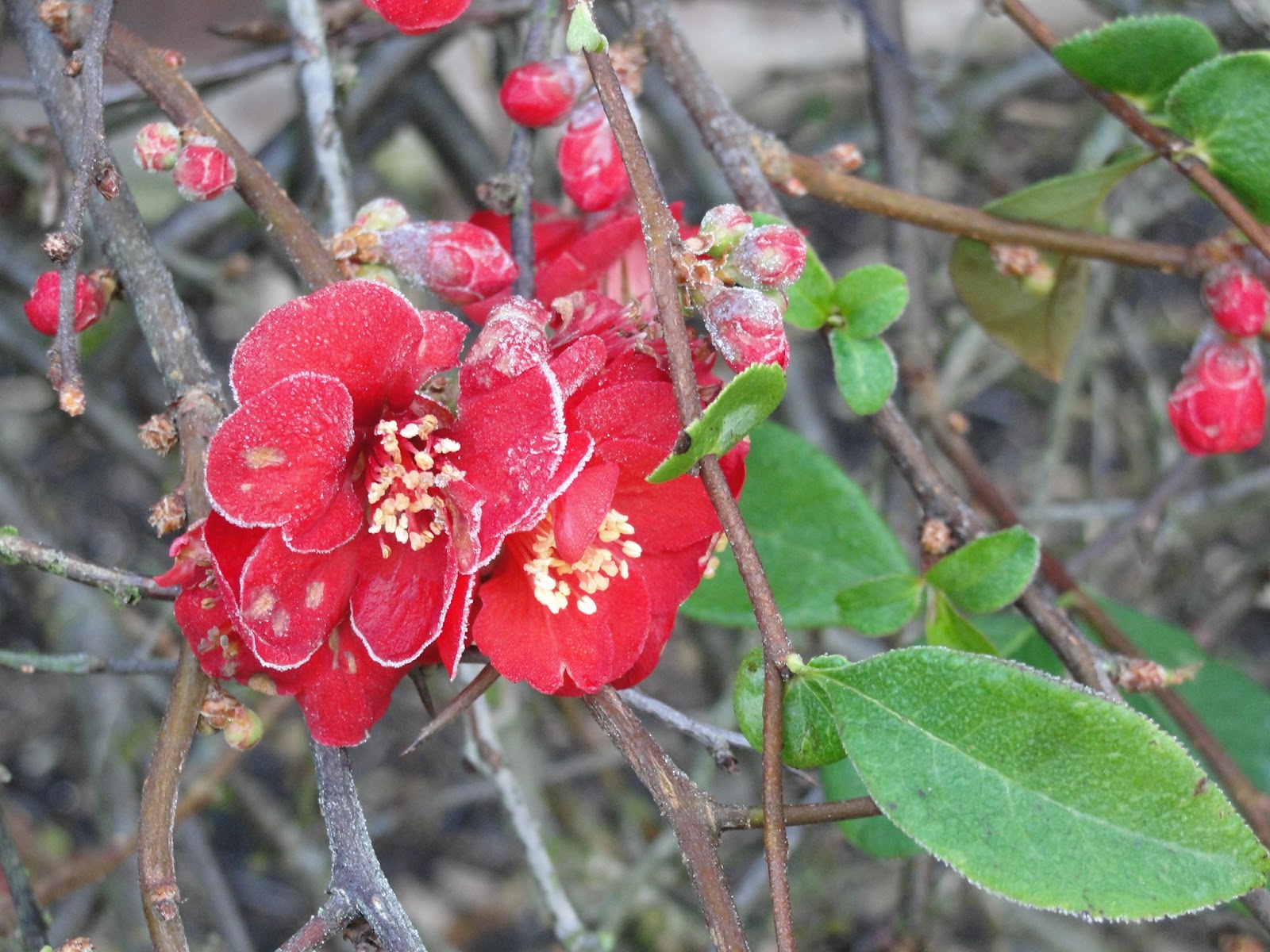
Should you get the chance then it is definitely worth having a wander across to Churchwood (22), as here will will find a shrub called Chaenomeles x superb 'Crimson and Gold'. This shrub has a fantastic display of red flowers that it is definitely worth seeing.
| 11 |
| 11 |
Carry on down to Priestley (4) and you will find 12) Helleborus x hybridus 'Peggy Ballard' and 13) Fuchsia 'Billy Green'.
| 12 |
| 13 |
We also have some lovely green foliage dotted around campus which does bring a lot of colour to the site in itself. At Carnegie (12) we have some 14) Phyllostachys bambusoides which provides a lovely green leaf with cream stems, and a 15) Aluba japonica 'variegata' which provides a variegated green and yellow spotted leaf for winter interest.
| 14 |
| 15 |
I hope you have enjoyed this visual walk around the Headingley campus with me. As you can see there really is still colour and interest going on out there in the winter time. No longer can you say there's nothing to see in winter, as clearly there is! Until next time, get wrapped up and get out there to enjoy the scenery.
(All photos were taken by myself on the 21st January 2016)
Tuesday, 19 January 2016
Installation of Bird Tables
Bird Tables on Campus
The tables were introduced as part of the wider biodiversity action plan we have to increase wildlife on campus and improve the diversity of species found.
The first one was placed by the raised pond at Carnegie Hall so is in an excellent position for staff to see, from their offices, the birds visiting the table.
The second was placed by The Cottage in a perfect position for the staff inside the building to see the table, but also for people sitting in the refectory across the road. It should be an excellent position to spot all the visitors to the table.
The third was placed in the front garden at North Lodge, again in a perfect spot for staff inside the building to watch the wildlife.
It will be fantastic to find out from the staff inside these buildings just what birds have visited the tables. So I will keep this blog posted for any sightings. Chances are theres will be some other creatures visiting the tables, such as squirrels but some of the feeders are specially designed to stop them from getting at the food, this will ensure that the birds are able to feed too.
The bird feeders will be topped up regularly in winter time by Paul to ensure the birds always have a supply of food should there not be many berries and seeds out there naturally for them. It has been suggested that feeders should only be used in the winter months when natural food supplies in the wild are low. That way the birds do not become reliant on bird feeders and are still able to forage for themselves. As birds use what they have found to feed their young in the springtime we do not want them relying on seed, as these can potentially choke the chicks as the seeds can sometimes get stuck in their throats. So we will do what we can to help them through the winter, then they have a fighting chance to survive the rest of the year.
(These photos were taken by myself on the 8th January 2016)
Winter Wonderland
Winter at the Headingley campus
As trees and shrubs have become dormant during the winter months (unless of course they are winter flowering), our tasks around the campus can change a fair bit. We've had a bit of frost so we have been out with our buckets of grit, spreading it on the paths to make it safe for staff, students and visitors alike.
Our day to day running of the campus in winter time mainly involves keeping on top of the weeding around all the buildings and collecting dead leaves that have accumulated at the bottom of stairwells and in the corners of buildings. As it has been rather mild we have been able to continue with some weeding but if the rain persists then even that can be called off. Unfortunately when the ground becomes so saturated with water we can’t step on as it causes such a muddy mess and isn't aesthetically pleasing at all.
When the rain has eased off and there's no chance of snow and the ground has dried out a bit, then we will be cutting back the roses on the borders of the James Graham building. These will ideally be cut back to a bud about a halfway down the stem, that way they still have some protection should we get frost and potentially snow. Then in March they will be cut down to the base to an outward facing bud to give a well rounded display of new growth in the summer, just in time for graduation.
From December to February we do plant barefoot deciduous trees and some of these can be seen at the student accommodation at Kirkstall Brewery. We have also planted some new trees in the Queenswood wood as part of the university’s biodiversity action plan.
Should the bad weather hold off then we will be able to use this time to cut back the shrubs across campus whilst they are dormant and get the borders looking tidy ready for their spring and summer blooms. If we do get a lot of frost then we won’t be able to do this as by cutting back the stems we are making them more susceptible to frost damage. A downward angle rather than a horizontal cut across the stem is needed, as this then provides a slope for the water to runoff so that it isn’t sitting on top of the stem causing damage.
Then, no doubt there will be some more frost, ice and snow. So I’m sure you’ll see the grounds team out there with our buckets and sticks spreading grit on the pavements, keeping the campus safe to walk around.
(The picture above was taken in January 2013 by myself in the Queenswood wood, and hopefully we won't get snow like that this year)
What to do at home in your garden in January
- Prune your wisteria to 2-3 buds on its summer shoots.
- Prune your roses and plant bare root roses. Ensure these aren’t planted where roses have already been as this will minimise potential disease transference.
- Cut back any old foliage from ornamental grasses to a few centimetres above ground.
- Cut down any old stems of perennial plants. Or leave them another month to allow biodiversity to thrive in your garden. The old hollow stems provide shelter for insects over the winter period.
- Remove old hellebore leaves to provide room for new growth to be visible.
- Cut back damaged, diseased and old stems of brightly coloured willows and thin out.
- Protect non frost-proof containers with bubble wrap, hessian or fleece, to prevent them from cracking.
- Collect any leaves and weeds from your tubs and borders.
- Plant barefoot deciduous trees.
- Prune your deciduous trees, such as beech and hazel, to create the shape you’re after whilst they are in their dormant season. The only exceptions are evergreens, tender plants and the Prunus species (cherry etc) as these are prone to silver leaf disease when pruned in autumn or winter.
- Now is the time to cut back vines and ivy to keep them away from windows, doors, gutters and roof tiles.
Welcome to the university!
Welcome to Leeds Beckett University, Headingley Campus
This blog has been created to give you an insight into just what the grounds maintenance team get up to around the campus. The purpose of this blog isn't just to show you what we do, but to also show you what you can do in your own gardens at certain times of the year.
I am Louise Stephenson, one of the Grounds Maintenance Assistants, and amongst other things it is my job to tend to the borders and grass around several of the buildings. Hopefully through my blog, you will get an idea of just what we get up to and how we create the beautiful grounds you see before you on a day to day basis.
We are a team of six grounds maintenance assistants (myself, Carl, Paul, Jen, Rach, and Mark), one apprentice (Sam) and one manager (Peter), covering a site set in 100 acres of park land. We also work on the city campus site now and then keeping it looking neat and tidy. Generally, Rach and Mark work on the sports side of the campus covering the football, rugby, and athletics areas, whilst the rest of us work on the 'floral' side. I say floral but this covers the entirety of the site from the greenhouse to the woodland to the buildings' borders.
I hope you enjoy this blog and feel free to leave any comments about what you'd like to see in future posts and any horticultural questions are more than welcome. Hopefully between the eight of us we will be able to answer your queries.
#wellmet #leedsbeckettuniversity #gardening #biodiversity
(The picture above was taken in June 2015 by myself)
Subscribe to:
Posts (Atom)